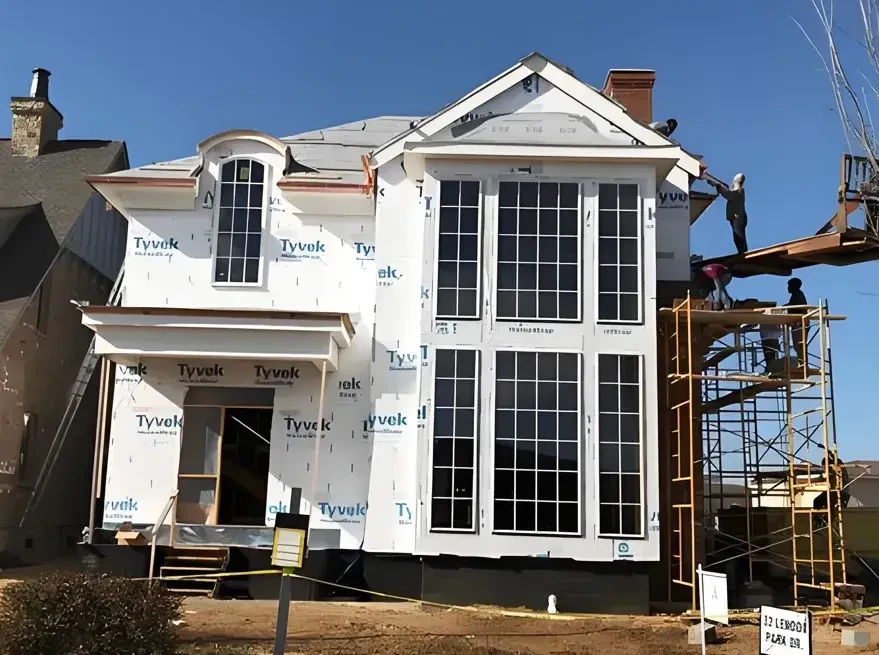
Tyvek homewrap and housewrap are the same product category — the trade uses both names — and both describe the weather-resistant barrier wrapped around the exterior sheathing of a building. It is the least visible layer on a building, and the first one blamed when a wall gets wet. Water stains on interior finishes, condensation inside a cavity or a failed air test often trace back to a lapped seam, an unsealed penetration or a membrane that was never suited to site conditions.
This part of our Tyvek application series looks at the barrier as an assembly: the four functions it must perform, where homewrap and housewrap, wall wrap, roof underlayment and window flashing each sit, and the details that decide whether the system works. Archival, event-band and envelope applications are covered in the earlier parts.
1. The Four Functions a Barrier Must Perform
Water hold-out: shedding bulk liquid water driven by wind and rainAir control: limiting uncontrolled air movement that carries moisture into the cavityVapour permeability: allowing moisture vapour to escape so the assembly can dry as designedDrainage and continuity: letting water that passes the cladding drain away instead of being trappedA membrane that scores well on one function can fail another. A fully sealed, non-breathable sheet holds water out but can trap moisture in a cold-climate wall; a permeable sheet that is not taped at seams loses its air-control function.
2. Where Homewrap, Wall Wrap, Roof Underlayment and Flashing Sit
Homewrap and housewrap (wall wrap): applied directly over exterior sheathing on timber-frame, light-gauge steel and modular buildings, behind the claddingRoof underlayment: a secondary layer beneath tiles or metal roofing, giving temporary weather protection during construction and a backup drainage path afterwardsWindow and door flashing: integrates the barrier around openings, where most water intrusion beginsTemporary site protection: short-term shielding of structural assemblies before cladding is installedThese are not interchangeable. Using wall wrap as roof underlayment, or skipping the flashing integration at openings, is a common source of callbacks.
3. What to Compare on a Datasheet
Water hold-out: hydrostatic head or equivalent water-resistance valueVapour permeance: measured permeability, matched to the climate and wall designAir resistance: whether the membrane is specified as part of the air barrierTear and tensile strength: relevant to jobsite handling and fastener pull-throughUV exposure limit: the documented period the sheet can stay uncoveredTemperature performance: flexibility and handling at low site temperaturesRoll width and length: fewer seams mean fewer failure pointsAsk for the test method as well as the number; values without a method cannot be compared.
4. Installation Details That Decide Performance
1. Lap seams in the direction that sheds water, with the upper sheet over the lower.
2. Tape or seal every seam with a compatible tape; a lapped but untaped seam is not an air barrier.
3. Sequence flashing so the barrier drains over the flashing, not behind it, at sills and heads.
4. Stagger fasteners and avoid over-driving; a torn fastener hole is a leak path.
5. Terminate correctly at the base so water can drain out rather than collect behind the membrane.
6. Protect the sheet from UV beyond its documented exposure window.
5. Common Failure Points
Reverse lapping at horizontal seams, which funnels water into the wallUntaped penetrations for pipes, conduits and ventsIncompatible sealants that lose adhesion after thermal cyclingBarrier left exposed past its UV limit before claddingRoof underlayment that is not turned up at walls and valleysRetrofit work that adds a barrier without addressing existing trapped moisture6. Timber Frame, Metal Building and Retrofit
Timber frame: the barrier works with sheathing and insulation to control air and vapour; continuity at plate lines and openings matters mostMetal building: fastener penetrations are frequent, so tear strength and sealing washers become more important than in a nailed timber assemblyRetrofit: the assembly already has a moisture history; the new barrier should not seal in existing damp, and ventilation paths should be confirmed first7. Procurement Checklist
1. Match the product to the assembly and climate, not only to the price per roll.
2. Request datasheets with test methods for water hold-out, permeance and UV exposure.
3. Confirm roll widths that reduce seam count on your typical wall height.
4. Check tape and flashing compatibility before ordering accessories separately.
5. Order sample rolls and run an installation trial on a mock-up panel.
6. Confirm batch consistency and lead time against the project schedule.
8. Sourcing Chinese Tyvek Homewrap
Most buyers searching for Chinese tyvek homewrap want a qualified second source that keeps the physical profile of the grade they already use. Evaluate it the same way as any building-envelope component:
Ask for made in China homewrap datasheets that state the test method, not headline numbers aloneCompare water hold-out, vapour permeance and UV exposure against the grade in use todayCheck batch-to-batch consistency before committing to a project-scale orderConfirm roll widths that match your wall heights and reduce seam countRun a mock-up installation with the tapes and flashing you intend to useChinese flash-spun mills now supply tyvek homewrap and made in China housewrap substrate in jumbo rolls with custom slit widths, which suits converters building regional product lines. Match the specification to the assembly first; origin is a sourcing decision, not a performance claim.
Conclusion
A building envelope performs as a system, not as a single roll of membrane. The barrier, tapes, flashing and installation sequence have to be specified together, and the datasheet has to be read with the test method attached. Get those right and the membrane does its job quietly for the life of the building.
If you are developing homewrap, housewrap or underlayment products from Chinese tyvek homewrap substrate, contact our team for datasheets, sample rolls and custom slit widths.