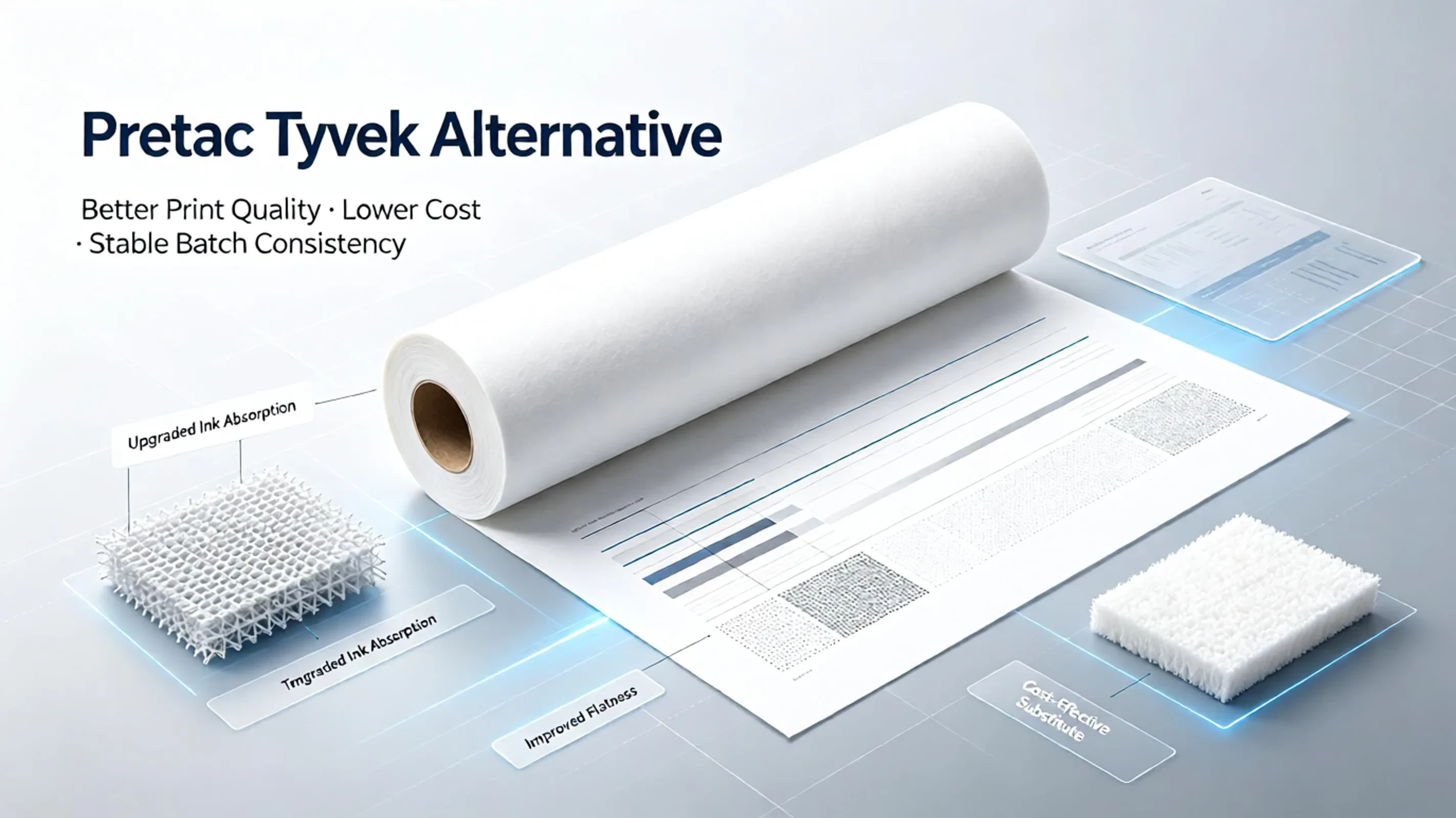
Pretac Flash-Spun Substrate: A Print-Optimized Tyvek Alternative for Graphic and Label Converting
By Technical Team
Most Tyvek alternatives are judged only on whether they match the physical specs of the original grade. For printers and converters, that is the wrong test. A substrate can hit the same tear and water-resistance numbers and still ruin a print run through mottling, dot gain, slow drying or micro-wrinkle pattern deviation. Pretac flash-spun substrate was developed around that second problem: how the sheet behaves on press, not only how it behaves in a tensile test.
This article looks at the print-side engineering of the material and how to evaluate it before a production switch.
1. Ink Absorption and Print Reproducibility
Conventional flash-spun grades carry an inert, loosely bonded fiber surface. Under UV, latex, eco-solvent and offset printing this can produce uneven ink adhesion, slow drying, faded color output and dot deformation.
Pretac applies refined fiber calibration and a dedicated surface micro-treatment to build a uniform ink-receiving layer. In practice that means:
2. Surface Flatness and Batch Consistency
Micro-wrinkles and uneven fiber distribution are the usual cause of pattern deviation and waste on long runs. Flatness is not a cosmetic property for a printer; it decides whether a job can be set up once and left to run.
Pretac controls spinning tension, hot-forming and post-finishing per batch, targeting:
3. Converting Behaviour: Slitting, Sealing and Handling
Print quality is only half of the conversion story. Pretac substrate is supplied with converting in mind:
4. Where the Cost Case Actually Shows Up
The cost argument for a print-optimized substrate is not only the purchase price per roll. Most of the saving comes from what does not happen on the line:
Price per kilogram matters, but total cost per accepted square metre is the number that decides a switch.
5. Where Print-Optimized Substrate Pays Back
The material is most relevant to work where print quality carries the value:
For applications where print is not critical, a standard grade may be the more economical choice. Match the substrate to the job.
Conclusion
Pretac flash-spun substrate is positioned as a print-first Tyvek alternative: it keeps the core flash-spun physical profile while improving the surface behaviour that decides print yield. If your reject rate or setup time is driven by substrate inconsistency, a trial roll is the fastest way to test the claim.
Contact our technical team for grade samples matched to your press type, ink system and finishing process.