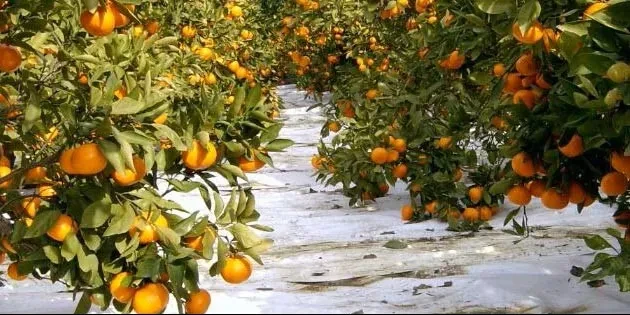
Tyvek Agriculture: Reflective Mulch for Citrus, Apple & Peach Orchards (2026)
By Technical Team
In Tyvek agriculture, reflective mulch functions as a quality tool rather than a decoration. In orchard production, the light that reaches the lower and inner canopy decides how evenly fruit colours and how consistently sugar accumulates. A mulch sheet that throws bright light in one direction can burn the fruit it is meant to help; a sheet that spreads soft light through the canopy supports even ripening without hotspots.
This part of our Tyvek application series covers agricultural mulch: how diffuse reflection works, what a mulch sheet must survive in an orchard, and how to specify and install it for citrus, apple and peach blocks.
1. Why Orchards Use Reflective Mulch
The benefit comes from the whole system, not from a single reflectivity number printed on a datasheet.
2. Diffuse vs Direct Reflection
Aluminium metallised film has a high direct reflectivity, and that is exactly the problem. Concentrated directional light creates hotspots on fruit surfaces and raises sunburn risk. It also tends to bounce off the outer canopy rather than reach the inner branches.
Diffuse reflection works differently: the sheet scatters light in many directions, so it reaches lower leaves and fruit inside the canopy more evenly. The result is softer light, lower burn risk and more uniform exposure.
A second difference appears over time. Aluminium coatings can delaminate under continuous UV exposure, and reflection falls away before the season ends. A UV-stabilised white non-woven keeps its diffuse performance across the planting cycle.
3. What a Mulch Sheet Has to Survive
A thin decorative film can look correct on day one and fail by mid-season. Ask for UV exposure data, not just initial reflectivity.
4. Matching the Sheet to the Crop
Roll width should follow the bed or row, not the other way round. Fewer seams mean fewer places for wind to catch.
5. Installation and Season Management
6. Comparing Mulch Options
The right choice depends on whether the block needs light management, moisture control or both.
7. Tyvek Mulch Alternative Sourcing
Growers and distributors searching for a tyvek mulch alternative usually want the same diffuse behaviour and UV durability without the lead time and cost of imported original material.
Chinese flash-spun mills now produce reflective agricultural mulch sheet in jumbo rolls with custom widths. When comparing offers, check:
Sample a roll on a small block before a full-season order; mulch performance shows up under wind and sun, not on a spec sheet alone.
8. Frequently Asked Questions
Q: Is higher reflectivity always better for fruit colouring?
A: No. Very high direct reflection can concentrate heat on fruit surfaces. Even, diffuse light across the canopy is usually more useful than a single high number.
Q: Can reflective mulch replace irrigation management?
A: No. It buffers surface evaporation, but irrigation scheduling still depends on soil and weather. The sheet supports moisture stability rather than replacing it.
Q: How long does a reflective mulch sheet last?
A: Service life depends on UV stabilisation, wind exposure and handling. Ask the supplier for the tested open-field exposure period rather than a generic claim.
Q: Does the sheet work on apple and peach as well as citrus?
A: The same diffuse principle applies. Width, anchoring and timing are adjusted to row spacing and canopy size.
Conclusion
Reflective mulch is a light-management tool with a secondary moisture benefit. The specification that matters is not the headline reflectivity but the combination of diffuse scatter, UV stability, permeability and tear strength under real orchard conditions.
If you are evaluating reflective agricultural mulch for citrus, apple or peach blocks, contact our team for roll samples and technical data.
한국어 버전
과수 재배에서 착색과 당도 관리는 수확 품질과 판매 가격을 결정하는 핵심 요소입니다. 특히 제주 감귤 산업에서는 햇빛을 어떻게 활용하느냐에 따라 과일 등급 차이가 크게 나타나기 때문에 타이벡 농업용 멀칭지가 주목받고 있습니다. 타이벡 반사멀칭은 단순히 빛을 반사하는 일반 필름과 달리 난반사 특성을 가진 농자재로, 제주 감귤 재배 현장에서 널리 사용되는 소재입니다.
타이벡 난반사 멀칭과 알루미늄 증착 필름의 차이
많은 농가에서 알루미늄 증착 멀칭지가 반사율이 더 높은데 왜 타이벡 멀칭을 사용해야 하는지 묻습니다.
알루미늄 증착 필름은 직접 반사가 강합니다. 강한 직접 반사광은 과일 표면에 국부적인 고온을 만들어 일소(햇볕 화상) 피해를 일으키기 쉽고, 빛이 고르게 퍼지지 않아 수관 안쪽과 아래쪽 과일까지 도달하기 어렵습니다. 또한 장기간 자외선에 노출되면 알루미늄 층이 벗겨지면서 반사 성능이 빠르게 떨어집니다.
타이벡 난반사 멀칭은 빛을 부드럽게 흩어 반사합니다. 빛이 수관 전체에 고르게 확산되어 착색이 균일해지고 당도 형성이 안정적으로 유지됩니다.
타이벡 농업용 멀칭지의 주요 장점
타이벡 멀칭 대체품과 중국산 소재
최근 공급망 변화로 한국의 농자재 유통업체와 과수원 운영자들이 타이벡 멀칭 대체품을 찾고 있습니다. PRETAC의 중국산 난반사 멀칭 소재는 유사한 난반사 메커니즘과 자외선 안정성을 갖춘 소재로 공급되며, 기존 수입 제품의 긴 리드타임과 높은 단가 부담을 줄이는 선택지가 됩니다.
자주 묻는 질문
Q: 반사율이 더 높은 알루미늄 증착 필름이 있는데 왜 타이벡 계열 멀칭지를 선택해야 하나요?
A: 반사율 수치만 높다고 농사에 유리한 것은 아닙니다. 알루미늄 증착 필름은 직접 반사가 강해 일소 위험이 있고 코팅이 벗겨지기 쉬우며 통기성이 없습니다. 저가 난반사 필름은 자외선 저항이 약해 한 시즌을 버티기 어렵습니다. 타이벡 계열 멀칭은 균일한 난반사, 통기성, 내자외선, 인장강도를 함께 갖춘 소재입니다.
마무리
타이벡 농업용 멀칭지는 단순한 반사 필름이 아니라 과수 품질 관리를 위한 기능성 농자재입니다. 제주 감귤 재배 현장에서의 사용을 바탕으로 사과, 복숭아 등으로 적용 범위가 넓어지고 있습니다. 타이벡 반사멀칭 또는 대체품을 찾는 유통업체와 농가는 PRETAC에 샘플 테스트를 문의하실 수 있습니다.