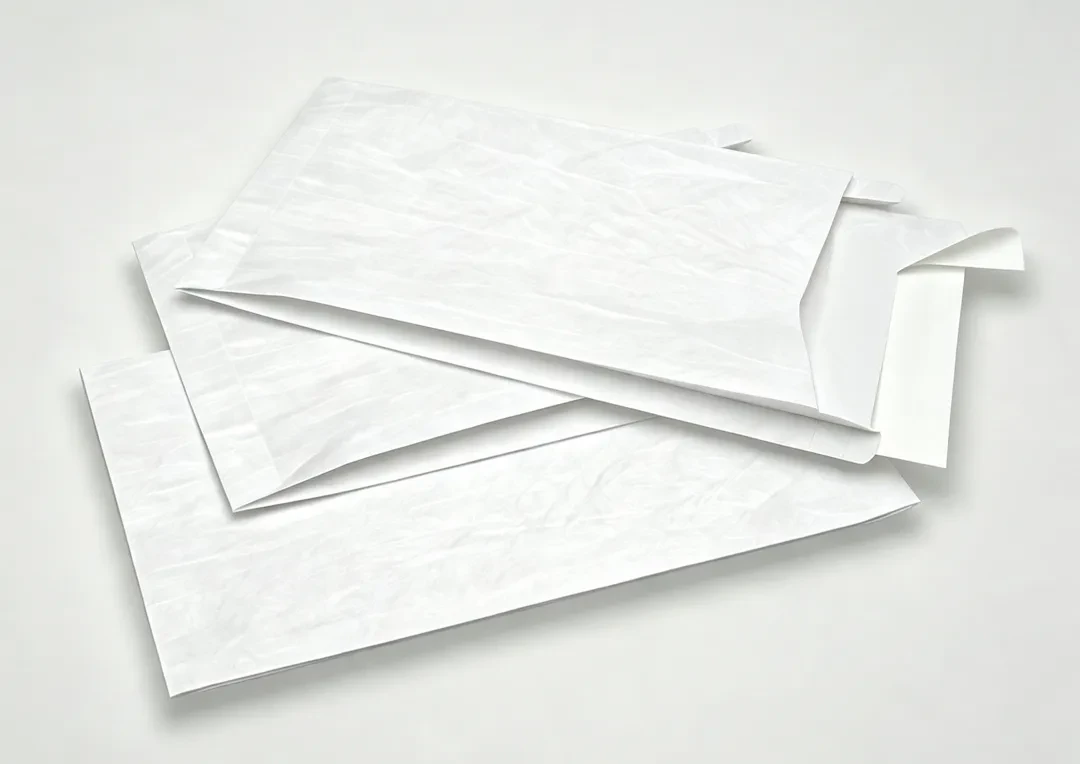
Tyvek Application Series Part 1: Envelopes — Why Flash-Spun Non-Woven Mailers Still Matter
By Technical Team
Paper envelopes are a mature, low-margin category, and digital communication has steadily reduced everyday mail volumes. Yet the envelopes that carry contracts, certificates, credentials and other high-value documents have not lost their importance. In these scenarios the question is not whether an envelope is made of paper, but whether it survives sorting, transit and humid storage without damage, and whether it can be secured against tampering.
Flash-spun HDPE non-woven, the substrate family commonly associated with the Tyvek brand, is built for exactly that requirement. This first part of our Tyvek application series looks at where Tyvek-grade non-woven envelopes are used, the six performance advantages that separate them from kraft paper, and how made-in-China substrate has changed the cost equation for envelope converters.
Main Application Scenarios for Tyvek-Grade Envelopes
Traditional paper envelopes have seen heavy volume decline under digital transformation. Email, e-invoicing and electronic document signing replace most routine personal and ordinary business mail, forcing many conventional envelope factories to downsize or restructure.
Even so, physical envelopes still hold irreplaceable value for high-importance hard-copy documents and special-purpose shipping. Flash-spun non-woven envelopes serve these critical-need scenarios:
Core Advantages of Flash-Spun Non-Woven Envelopes
Compared with ordinary kraft or heavy-weight paper envelopes, envelopes made from Tyvek-grade flash-spun non-woven deliver distinct functional strengths:
Market Pain Point: Imported Substrate Cost for Envelope Production
Even though flash-spun non-woven envelopes offer clear functional benefits, many converters and distributors still hesitate to scale the product. Imported Tyvek-grade jumbo rolls carry relatively high landed costs, and for mass-produced specialty-envelope lines those substrate prices compress profit margins and limit market penetration for end-users.
Made-in-China Tyvek Alternatives Open New Sourcing Options
Chinese material manufacturers such as Pretac have developed full-chain flash-spun non-woven production capability. Qualified Tyvek-alternative substrate for envelope production is now exported worldwide, giving envelope converters a practical second source for jumbo rolls.
This China-origin flash-spun jumbo-roll material delivers closely matched core physical performance, including tear resistance, water repellency, print-running compatibility and reusability, meeting most technical specifications for specialty envelope manufacturing. At the same time, it removes part of the historical premium pricing, allowing envelope converters to reduce raw-material landed costs without sacrificing finished-goods quality.
Beyond cost benefits, Chinese factories bring extra practical merits for envelope producers: flexible minimum-order quantities, adjustable grammage options, shorter production lead times, and responsive technical support for slitting and converting requirements.
Industry Outlook: A Steady Supply-Chain Shift
Digitalisation will keep shrinking demand for common plain paper envelopes. Yet high-value, function-driven specialty envelopes for confidential documents, official certificates, secure transit and brand-custom projects should maintain steady global demand.
Lower landed costs, stable mass-supply capacity and flexible order conditions are driving more international purchasers to evaluate Chinese-manufactured flash-spun substrates. For global envelope converters, printing houses and material distributors, it is a practical window to run sample comparison and technical validation for made-in-China Tyvek envelope raw material. Building secondary-source supplier resources in advance helps reduce single-source supply risk and optimise the cost structure.
Conclusion
Envelopes remain a proven, classic application for flash-spun HDPE non-woven. While general-purpose paper-envelope volumes keep shrinking in the digital era, durable, secure specialty envelopes remain irreplaceable for important physical documents and special-item mailing.
Today, mature Tyvek-alternative material manufactured in China gives converters a balanced option between reliable performance and improved cost efficiency. Distributors and manufacturers are advised to complete material assessment and supplier layout ahead of time to capture new business opportunities from this changing global material market.