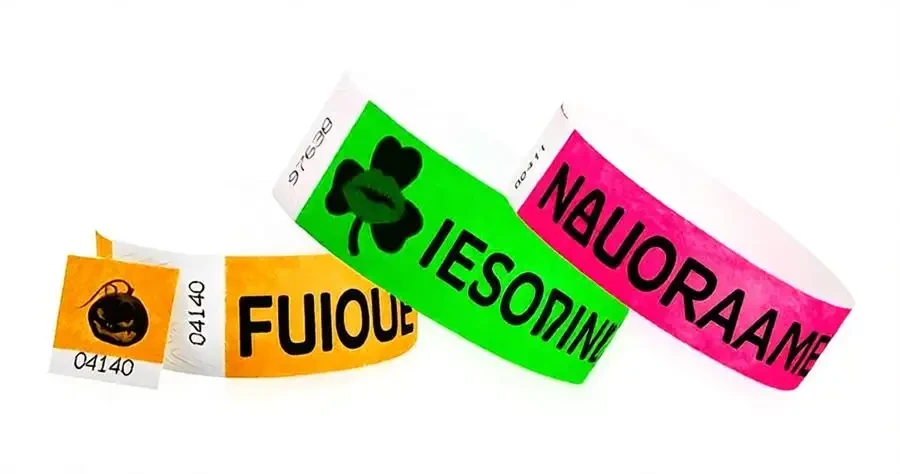
A wristband looks like the least important item on an event checklist, until it fails. A band that tears at the gate slows entry, a band that can be slipped off undermines access control, and a band that irritates skin turns a medical ID into a complaint. Tyvek wristbands are chosen because they handle those three failure points better than most disposable alternatives.
This guide covers what the material is, where it is used, how it compares with PP and standard HDPE bands, and how to specify construction and print for a real event programme.
What a Tyvek Wristband Actually Is
A Tyvek wristband, also sold as an event ID band or bracelet, is a die-cut strip of flash-spun HDPE non-woven with a pressure-sensitive adhesive closure. Three elements decide how it performs:
Substrate: flash-spun HDPE non-woven, the same material family sold under the Tyvek brandClosure: an adhesive overlap that bonds to the band surface on first fasteningConverting: die-cut shape, size, colour and print applied before dispatchBecause the closure bonds on contact, the band cannot be peeled and re-applied without leaving visible fibre damage. That is the basis of its tamper-evident function.
Where Tyvek Wristbands Are Used
Concerts, festivals and live performances: general admission, VIP, backstage and crew tiersExhibitions and trade fairs: attendee identification and zone accessTheme parks, water parks and resorts: day admission and re-entry permissionHospitals and clinics: patient and infant identification where single-use bands are requiredBars and venues: age verification and capacity wristbandingSchools, camps and youth programmes: group classification and child safety markingCharity galas, sports events and community festivals: fast on-site issuance at volumeTyvek vs PP vs Standard HDPE Wristbands
Tear resistance: flash-spun non-woven resists ripping better than thin PP film or standard HDPE film under crowd handlingBreathability: the fibrous structure lets moisture vapour pass, so the band stays drier on a full-day wearerSecurity: once fastened, a Tyvek band shows visible breakage on removal, which supports access controlPrintability: offset, UV and digital printing, plus barcode, QR code and serial numberingWriting surface: names and emergency notes can be written directly on the bandComfort: pH-neutral and low-irritation, including for infant ID usePP bands can be cheaper per unit for very short indoor events, but they trade away breathability and, in thin grades, tear resistance.
Specifying Construction for Your Event
Closure: standard adhesive, or extended adhesive for larger wrists and adjustable sizingSize: measure the wrist and add overlap; undersized bands fail at the closureSecurity level: sequential numbering, custom colour coding or holographic elements for high-value zonesDurability window: single-day, multi-day with re-entry, or extended-wear medical useFinish: matte for writable surfaces, gloss for stronger colour reproductionVolume: confirm die-cut and print capacity before committing to an on-site issuance planPrint and Variable Data Workflow
Wristbands are usually printed as sheets or rolls and then die-cut. For events that need individual credentials, variable data changes the workflow:
1. Decide whether the band carries static artwork, a serial number, or a unique barcode or QR code.
2. Confirm the scan distance and lighting at the gate; barcode contrast matters more than artwork detail.
3. Test the code on the actual substrate, because porous non-woven can reduce edge sharpness.
4. Plan a manual fallback check in case scanners fail at peak entry.
Bulk Procurement Checklist
1. Request sample bands in the exact size, closure and finish you plan to order.
2. Wear-test a sample for a full day, including water and sunscreen exposure.
3. Confirm the adhesive holds on the substrate at the expected temperature and humidity.
4. Ask for batch consistency data if the order spans multiple production runs.
5. Order a small buffer above expected attendance; on-site shortages are hard to fix.
6. Confirm lead time against your event date, including print and die-cut, not just material supply.
Conclusion
Tyvek wristbands are a functional choice, not a decorative one. They are specified when tear resistance, tamper evidence, breathability and printability all matter at the same time. Match the construction to the event, test a sample before the order, and the band stops being a risk item on the checklist.
For sample bands, custom sizes and variable-data printing, contact our team with your event profile and expected volumes.